Voima Weekly #46 – Is 0% Gold the Blind Bet?
Marko Viinikka
Toimitusjohtaja
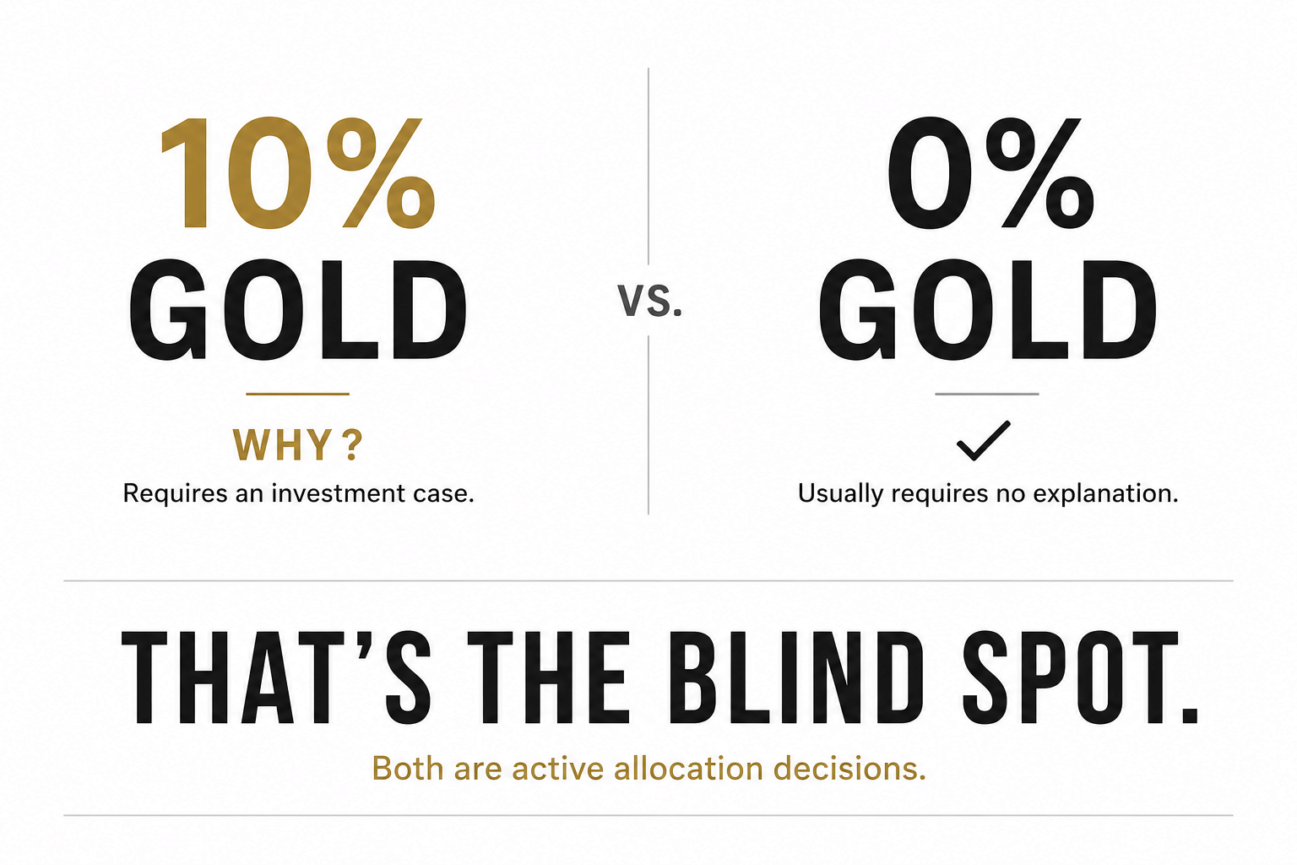
A 0% gold allocation and a 10% gold allocation are both active allocation decisions. Only one is usually required to justify itself.
Back from a short writing break. Let’s get straight to the point.
If an institutional investor proposes a 10% allocation to gold to an investment committee, the questions come immediately. Why gold? Why exactly 10%? Why now? Which asset class will fund the allocation? What happens to returns? What about risk?
If the proposal is 0% gold, the same questions are rarely asked. Zero is easily perceived as the neutral starting point. But it isn’t. A 0% gold allocation is an allocation decision just as much as 10% is. And if 10% requires a strong investment case, why shouldn’t 0%?
Rhetoric is not enough. So we asked a simple question: what would have happened historically to an institutional portfolio if its strategic allocation to gold had been 0%, 2.5%, 5%, or 10%?
In a portfolio backtest based on long-term monthly historical data, the results pointed consistently in one direction1:
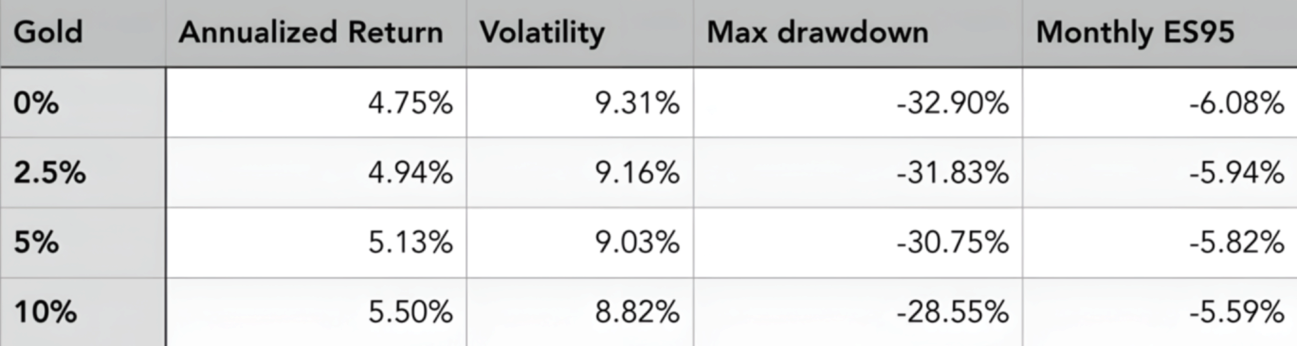
Annualized return = average annual return. Volatility = the degree of fluctuation in the portfolio’s value. Max drawdown = the largest decline from peak to trough. Expected Shortfall (95%, monthly) = the average loss during the worst 5% of months.
In the model tested, increasing the gold allocation coincided with both higher historical returns and lower measured risk. The usual diversification trade-off did not appear in this dataset. A 0% gold allocation was not the best-performing portfolio on any of these metrics.
But let’s stop here: this does not prove that 10% is the right answer. A backtest is a backtest. It tells us about the past, not the future. It does not explicitly prove that gold’s historical diversification benefits will persist, that 10% is the optimal allocation, that gold at today’s price offers an attractive forward return2, or that every institutional investor should own gold.
In fact, a 0% allocation can be entirely rational. But in that case, the rationale must be forward-looking3. In practice, the investor must believe that the future will differ sufficiently from what the long historical record suggests. This is the key distinction. In this model, the historical data does not provide an argument in favor of a 0% allocation. That argument must therefore come from a view of the future.
At this point, the question becomes more interesting: what if the world has changed in gold’s favor?
A 2025 Finance thesis at Aalto University examined the drivers of gold prices using data from 2000 to 20254. Models estimated using pre-2020 data lost significant explanatory power in the post-2020 environment. In particular, the traditional inverse relationship between gold and long-term interest rates weakened. The old model no longer described the new gold market as well. The study does not provide a definitive answer as to why this happened. And that leads to the next important question.
If gold’s behavior has changed, it is worth looking at who is buying it.
The first major shift can be seen in central banks. According to the World Gold Council, central banks have purchased an average of approximately 1,000 tonnes of gold per year over the past four years5. During the preceding decade, the average was around 500 tonnes per year. In other words, the annual pace of central bank gold buying has effectively doubled.
In 2025, central banks still purchased a net 863 tonnes of gold. This represented approximately 17% of total global gold demand of around 5,000 tonnes.
Nor does this appear to be merely a past wave of buying. In the World Gold Council’s 2026 central bank survey, 89% of reserve managers expected global central bank gold reserves to increase over the next 12 months. A record 45% expected their own central bank to increase its gold holdings, while 83% believed gold’s share of global reserves would be higher than today five years from now.
Central banks are, of course, not ordinary institutional investors. Their objectives and responsibilities are different. But their behavior is difficult to ignore. The managers of the world’s largest reserves are not behaving as if gold is becoming less relevant. Quite the opposite.
At the same time, the shift is not limited to central banks.
In 2025, global gold investment demand rose to 2,175 tonnes, 84% higher than the previous year. Physically backed gold ETFs saw net inflows of 801 tonnes, the second-highest level on record; bringing their combined gold holdings to a record 4,025 tonnes6.
The geographical distribution is also interesting. North American gold funds increased their holdings by 446 tonnes in 2025, Asian funds by 215 tonnes, and European funds by 131 tonnes. The shift was particularly pronounced in China. Holdings in Chinese gold ETFs more than doubled during the year, with 133 tonnes flowing into the funds. At the same time, Chinese bar and coin demand rose to 432 tonnes, up 28% year-on-year. In India, comparable demand reached 280 tonnes, an increase of 17%.
These are strong numbers, but they still do not prove that the gold price will continue to rise. What they do tell us is something important about the structure of gold demand. It is not simply the same investors buying slightly more. Demand is coming from multiple sources, across different geographies, and for different reasons.
A central bank does not buy gold for the same reason as a US ETF investor. A Chinese saver does not make the same decision using the same framework as a European portfolio manager. Or is there ultimately a common problem behind all of them?
Our view is simple: governments spend more than they collect, debt is likely to keep growing, and the supply of fiat money will continue to expand over the long term. Different investors respond to this in different ways, but the underlying need for protection may ultimately come from the same source.
If marginal demand for gold is changing, it is entirely possible that gold’s historical pricing relationships are changing as well. And that should lead institutional investors to ask: is our gold allocation built for today’s gold market, or yesterday’s?
There are at least credible explanations for this shift. Government debt and persistent deficits have changed the interest-rate environment: a high nominal interest rate does not necessarily mean tight money if debt is simultaneously being created at a persistent pace. Central banks are diversifying their reserves, and gold has one exceptional characteristic in this context: it is no one else’s liability. At the same time, geopolitical fragmentation has made the political and legal risks associated with reserve assets more visible. And if the marginal buyer of gold has changed, it is reasonable to ask whether the old relationships between gold, interest rates, and the dollar still work as they once did.
None of this, however, automatically makes gold a good investment. Gold produces no cash flow, and its value cannot be anchored to future cash flows in the same way as an equity or a bond. Its price has risen significantly. Real interest rates may remain high. Central bank purchases may slow. And the historical diversification benefit may prove smaller in the future than the backtest suggests.
A 0% gold allocation may therefore still be entirely the right answer. But it should be the conclusion of the analysis, not the starting point. That is the central idea of this Weekly.
We are not arguing that every institutional investor should hold 10% in gold. Nor are we claiming to know that gold will outperform other asset classes from here. We are making a much simpler point: 0% is not a neutral position.
If a 10% gold allocation requires an investment case from an investment committee, then 0% should also require justification, particularly in a world where historical portfolio analysis shows diversification benefits, gold’s traditional pricing relationships have weakened, central bank behavior has changed, and the debt and geopolitical environment looks very different from a decade ago.
Perhaps the bold bet is not owning gold after all.
Perhaps the blind bet is 0%.
A 10% gold allocation requires justification. So should 0%.
–Marko Viinikka
Founder, CEO
Voima Gold Oy
Disclaimer: Voima Weeklies are the personal writings of the undersigned. They do not necessarily represent the official view of Voima Gold Oy or any other company, nor do they constitute investment advice or a recommendation to purchase securities.
-
Voima Research / Joona Paappa. Portfolio backtest, monthly data, January 2001–August 2025. Gold allocations tested: 0%, 2.5%, 5%, and 10%. ↩
-
Forward return: the return expected from an investment from the present point forward. For an investor, historical return tells us what happened in the past; forward return estimates what return can realistically be expected in the future at today’s price and under current market conditions. ↩
-
Forward-looking: an assessment or view focused on the future, based on current market conditions, expectations, and assumptions rather than solely on historical outcomes. Forward return is one component of forward-looking analysis. ↩
-
Source: Paappa, Joona (2025), A Structural Shift in Gold Pricing After 2020: Out-of-Sample Breakdown of Conventional Models, Aalto University School of Business, Bachelor’s Thesis. https://aaltodoc.aalto.fi/items/f9379203-fa84-4527-bef4-83b0a856f8ed ↩
-
Source: World Gold Council, Central Bank Gold Reserves Survey 2026, 16.6.2026. ↩
-
Source: World Gold Council, Gold Demand Trends: Q4 and Full Year 2025 – Investment, 29.1.2026. ↩
You may like these
Below you will find related Voima Weekly publications where we explore economic developments, purchasing power, and the role of gold from different perspectives.2026-10-05
Voima Weekly #52 – Gold as Collateral for Government Debt?
The U.S. national debt has passed $40 trillion, and gold has entered the conversation. Could gold become collateral for a new kind of government bond?
2026-09-28
Voima Weekly #51 – Money and the Right to Step Outside the Digital Chain
Cash, Bitcoin and gold leave different traces. Gold can leave the digital chain, and return to it, without carrying every past transfer with it.
2026-09-21
Voima Weekly #50 – Winter Is Not a Matter of Opinion – Why Do I Write the Weekly?
The Weekly’s readership has grown to more than 4,000 subscribers. Marko Viinikka returns to the beginning: why the Weekly exists, how the economic weather is changing, and why Voima was built.
