Voima Weekly #53 – Same currency, different game
Marko Viinikka
Toimitusjohtaja
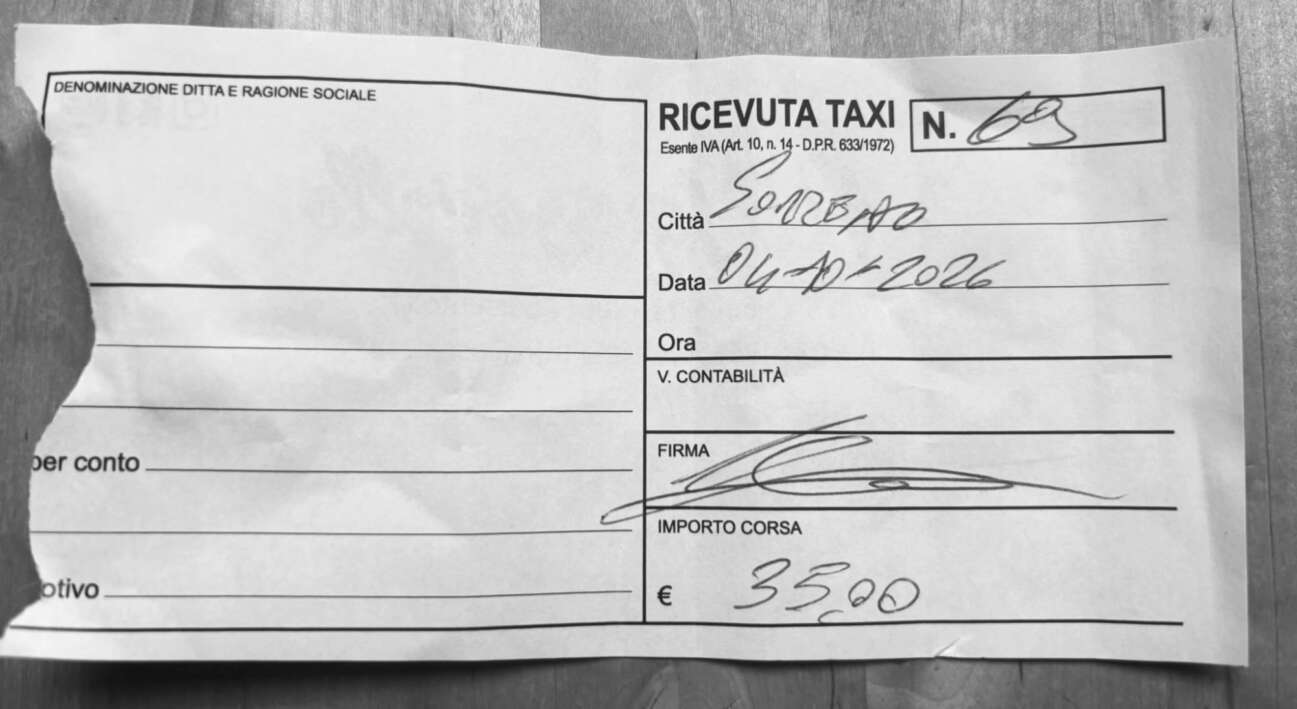
La dolce vita. A little less dolce for the accountant. A taxi receipt from our trip to Sorrento.
I’ve just returned from a week in Italy. We attended the precious metals conference organised by the LBMA (London Bullion Market Association) in Sorrento, together with the colleague responsible for Voima’s treasury and trading operations and our Chief Operating Officer.
Sorrento also has a personal significance for my wife and me: we got married there ten years ago. So it was lovely to return to these surroundings.
I’ve visited Italy countless times, and I’ll certainly go back. I love the country: the warmth, the scenery, the food, people’s joy for life and the healthy pride they take in their homeland.
One thing, however, kept coming up: getting a receipt. I paid particular attention to this because the trip included business expenses for which we needed proper documentation for our accounts.
In Finland, you get a receipt automatically. In Italy, getting one usually involved a separate negotiation. And when a receipt finally appeared, it could come in all sorts of forms. Cash was the preferred payment method. The card machine didn’t always work, prices were often negotiated in advance, and paying by card could mean paying more. The same pattern was familiar from ten years ago, when we paid for our wedding reception. Back then, ATM withdrawal limits made getting enough cash difficult. This time, you could withdraw as much as a thousand euros in one go.
One taxi receipt has made it into this Weekly as an illustration. It does not, on its own, prove tax evasion, but it captures the difference I experienced rather well.
In Italy, cash is far from a marginal payment method. According to the ECB’s 2024 study, cash accounted for around 61 per cent of transactions at physical points of sale in Italy (meaning only those for which a receipt is issued; transactions without receipts do not enter the statistics). In Finland, the corresponding share was 27 per cent.1
Cash is not the problem. It is a legal means of payment and plays an important role in privacy and resilience. But let’s also talk about the things people discuss around the kitchen table. Some money passes from one pocket to another without the sale being declared or taxes being paid. A service is provided, the buyer pays, and the money goes towards the next purchase. The economy keeps turning, but the state doesn’t get its cut.
This is more than a traveller’s observation. Italy’s national statistics office estimated that the shadow economy generated nearly €198 billion in value added in 2023.2
In my conversations, I’ve heard an argument that even a Finn can understand: Scusa, but the state wastes the money. You can’t trust it. Why should we give it even more?
In the eyes of the law, that obviously does not justify tax evasion. But you can understand someone’s decision without declaring it right. And yes, there are advantages for the person who leaves the tax unpaid. They keep more money, and the state gets less. When this happens year after year, the difference presumably builds up in private wealth too.
That does not mean tax evasion makes society as a whole richer. Someone else pays more, services are cut, or the state takes on more debt. But this is precisely the point: the interests of the individual, the state and the monetary union do not always align. What benefits one does not necessarily benefit the other two.
We share a currency, but not a common way of doing things. Finland and Italy use the same euro, and monetary policy is set by the European Central Bank together with the central banks of the euro area countries. Taxation and government spending, however, remain largely in national hands.
Finns are brought up to pay their taxes and trust that the system will look after them. Or at least that is how we have grown accustomed to thinking. In my view, that trust is now being severely tested. The mindset I encountered in Italy was different: look after yourself and your family.3 Don’t build your entire future on the state’s promises.
I’m not claiming that all Italians think this way, or that all Finns think the opposite. Nor can Europe be neatly divided into a virtuous north and a carefree south. But the difference I experienced is real.
Sharing the euro has not made us alike, and it never will. We have different taxes, different incentives and different relationships with the state. Yet we use the same currency and operate within the same central banking system.
Italy’s fiscal deficit is no new state of emergency. According to the historical data series, its last surplus year was 1925. It has run a deficit for a hundred consecutive years since then. When spending, including interest payments, exceeds revenue, the gap is financed by borrowing.4 And when existing debt matures, new debt can be issued to repay it.
How much support does this system receive? In Italy’s case, the sums are enormous. Taken together, the main EU recovery, employment, regional development and agricultural programmes allocate more than €300 billion in grants and loans to Italy.5
This is not a claim that Italy has received €300 billion in outright gifts over the past ten years. The total includes repayable loans and funding allocated to future years. Italy also contributes to the EU budget. But the scale of the funding is nevertheless very real.
Finland shares in the financing and liabilities of these joint arrangements. The cost of these decisions does not disappear simply because they are often made in Brussels rather than Helsinki.
The Eurosystem has also purchased enormous amounts of Italian public debt securities. At the end of September 2026, cumulative net purchases of Italian securities under the PSPP and PEPP programmes totalled approximately €500 billion. These purchases are, of course, not a donation: the debt remains debt, and the central bank holds a claim.6
Who benefits, and who pays? A deficit does not automatically mean inflation. Nor does Italy’s budget alone determine the euro’s purchasing power. But if the real burden of debt is reduced through inflation (as it has been so far), the bill does not stay within Italy’s borders. It travels with the shared currency.
When the euro loses purchasing power, so does a Finn’s euro. The number in your bank account may stay the same while buying you less.
Unexpected inflation can benefit borrowers if their debt carries a fixed interest rate and is denominated in euros. It harms creditors and cash savers. Someone who owns assets, a business and pricing power may be in a very different position from someone whose wealth consists entirely of euros.
So the beneficiaries are not simply “Italians”, and those paying are not simply “Finns”. The benefit may go to the recipient of debt-financed spending, someone who avoids paying tax, or a borrower whose debt shrinks in real terms. The costs may fall on a conscientious taxpayer, a holder of nominal claims, or a saver whose money fails to keep pace with prices. The same person can belong to several of these groups. What matters is your position.
The central bank itself does not rely solely on promises. During the central bank panel in Sorrento, Gioia Cellai of the Bank of Italy presented the history of the country’s gold reserves and the allocation of the central bank’s assets. Italy has retained approximately 2,452 tonnes of gold. In the presentation, gold formed part of an assessment of the entire balance sheet, alongside foreign exchange reserves, monetary policy portfolios and liabilities. This was also about how the balance sheet withstands adverse scenarios.
In his separate opening address, Bank of Italy Deputy Governor Sergio Nicoletti Altimari explained gold’s role as a safe haven and a source of diversification. He also highlighted the crucial distinction: gold is no one’s liability.7
KA central bank can hold governments’ promises to pay. But alongside them, it also keeps assets whose existence does not depend on anyone honouring a promise.
Why should an ordinary saver build their future entirely on promises?
Finland does not have to be the system’s gullible payer either. Finland has high taxes, work incentives that need fixing and questionable pension funding. If taking a job leaves you with too little money in your pocket, something is wrong with the system. If optimising benefits pays better than earning your own living, something is wrong with the system. And if the answer to funding problems is always higher taxes or a later retirement age, we should ask what we are being promised in return.
The pension system provides real rights and security. But in my own financial planning, I would not equate a future pension promise with wealth I own and can access.8
I’m writing this because I want to make visible what we have collectively chosen, in politics, in public debate and in the way we do things. We should be able to discuss alternatives without every difficult question being treated as inappropriate.
Leaving the euro is one option whose costs and opportunities should be open to discussion. Another is to drift towards a situation where people start working around the system because they no longer trust it. But I recommend a third: learning to operate better within the current system.
Finland needs to make use of shared funding, defend its interests and create incentives that help work, entrepreneurship and saving increase people’s net wealth.
The goal must not simply be to maximise tax revenue. The goal must be a prosperous nation. Finland has all the “right” conditions to demand a shift from net contributor to net recipient: unemployment among the highest in the EU, persistently weak economic growth and, yes, a long border with our eastern neighbour. We also have significant raw material resources whose development could strengthen security of supply across Europe.
We should be able to bring more to the negotiating table than an expression of concern. I would set a target of bringing at least €100 billion in shared funding to Finland over the next ten years: grants, affordable loans and investment financing for security, infrastructure, industry and raw material processing. That requires projects, allies and tough negotiations. But why wouldn’t we even aim for it? For comparison, Poland received an average of around €14 billion a year from the regular EU budget between 2022 and 2025. Recovery fund grants and loans come on top of that. Poland is much larger than Finland, but the comparison shows the scale of shared funding flowing through Europe.
At the same time, we need to create incentives that help work, entrepreneurship and saving increase people’s net wealth. The goal must not simply be to maximise tax revenue. The goal must be a prosperous nation.
Where is Finnish sisu if we don’t even dare ask whether the path we’ve chosen serves us well? I don’t want to give up on Finland. I want Finns to thrive. I want us to aim to become the wealthiest nation in Europe.
I don’t condemn Italians for trying to look after their families and keep the fruits of their labour. But we need to stop confusing conscientiousness with financial wisdom. We share the same currency, and that doesn’t mean we have to play by the worst possible rules.
Although the constant negotiations over receipts began to wear down my patience towards the end of the trip, I’ll happily return to Italy. And right now, it seems to me that when it comes to protecting family wealth, the Italian model has the upper hand.
Ci vediamo, Italia! Next time, I think I’ll bring the accountant a few souvenirs besides the receipts the Italians managed to cobble together...
–Marko Viinikka
Founder, CEO
Voima Gold Oy
Disclaimer: Voima Weeklies are the personal writings of the undersigned. They do not necessarily represent the official view of Voima Gold Oy or any other company, nor do they constitute investment advice or a recommendation to purchase securities.
-
ECB, SPACE 2024. The figures of 61% and 27% refer to cash payments as a share of the number of transactions at physical points of sale, not their euro value, the share of the shadow economy or people’s cash holdings. No comparable evidence has been presented here to establish that Italians hold several times as much cash as Finns. ↩
-
Istat: The shadow economy generated nearly €198 billion in value added in 2023. Including separately defined illegal activities, the total estimated size of the non-observed economy was €217.5 billion, or 10.2% of GDP . This figure represents neither lost tax revenue nor cash holdings. ↩
-
I have explored the economic foundations of this trust in earlier articles, including Weekly #47 - The €5,700 Problem, which examines young households’ low net wealth and their opportunities to build capital of their own. Weekly #48 - Is a Pension Contribution a Tax? discusses the difference between pension entitlements and personally owned wealth, as well as the changing terms of the pension system. I examine the broader obstacles to Finland’s prosperity in Weekly #40 - Why Is Finland Getting Poorer When It Has Every Opportunity to Prosper? ↩
-
In the historical data series, Italy’s last overall fiscal surplus was in 1925 (+1.7% of GDP), and its overall balance was negative in every year from 1926 to 2025. This long series combines statistics from different periods, with varying coverage and calculation methods; the earliest figures are not fully comparable with modern general government accounts. The overall balance includes interest expenditure. Italy has recorded a primary surplus in many years: revenue covered non-interest expenditure, but not all interest payments on its debt. Source: Osservatorio CPI, historical data series, March 2026; underlying sources: IMF, Banca d’Italia and Istat. ↩
-
The indicative total is approximately €306.4 billion: RRF €194.4 billion (€71.8 billion in grants and €122.6 billion in loans), SURE €27.438 billion in loans, REACT-EU €14.4 billion, cohesion funding for 2021–2027 approximately €42.2 billion, and CAP funding for 2023–2027 approximately €28 billion. This is the combined total of funding allocations and loans under different programmes, not the actual net transfers received over the past ten years. ↩
-
ECB programme statistics (APP, PEPP): At the end of September 2026, cumulative net purchases of Italian securities under the PSPP stood at €277.960 billion, and net purchases under the PEPP at €219.781 billion, totalling approximately €497.7 billion. This figure is the net purchase amount remaining in the programme statistics after purchases and maturities—not the sum of all historical gross purchases or a donation. It is also a different measure from the total central bank holdings described in the following footnote. ↩
-
Gioia Cellai participated in the central bank panel at the LBMA conference. The history of the gold reserves and the allocation model are shown in the PowerPoint slides she presented. Sergio Nicoletti Altimari delivered his separate opening address, “Gold between Continuity and Change”, in Sorrento on 5 October 2026. He discussed gold’s diversification benefits, its safe-haven properties and its independence from a counterparty’s promise to pay, as well as the effect of high public debt on demand for gold. ↩
-
https://www.voimagold.com/releases/weekly/is-the-pension-contribution-really-a-tax/ ↩
You may like these
Below you will find related Voima Weekly publications where we explore economic developments, purchasing power, and the role of gold from different perspectives.2026-10-05
Voima Weekly #52 – Gold as Collateral for Government Debt?
The U.S. national debt has passed $40 trillion, and gold has entered the conversation. Could gold become collateral for a new kind of government bond?
2026-02-08
Voima Weekly #26 - When Systems Buy Time
System erosion, production, debt, income transfers, and the EU structure.
2026-01-25
Voima Weekly #24 – Terms & Conditions
USA vs Europe: governance structure, debt, taxation, and the direction of the monetary system.
