Voima Weekly #59 – Sell-off
Marko Viinikka
Toimitusjohtaja
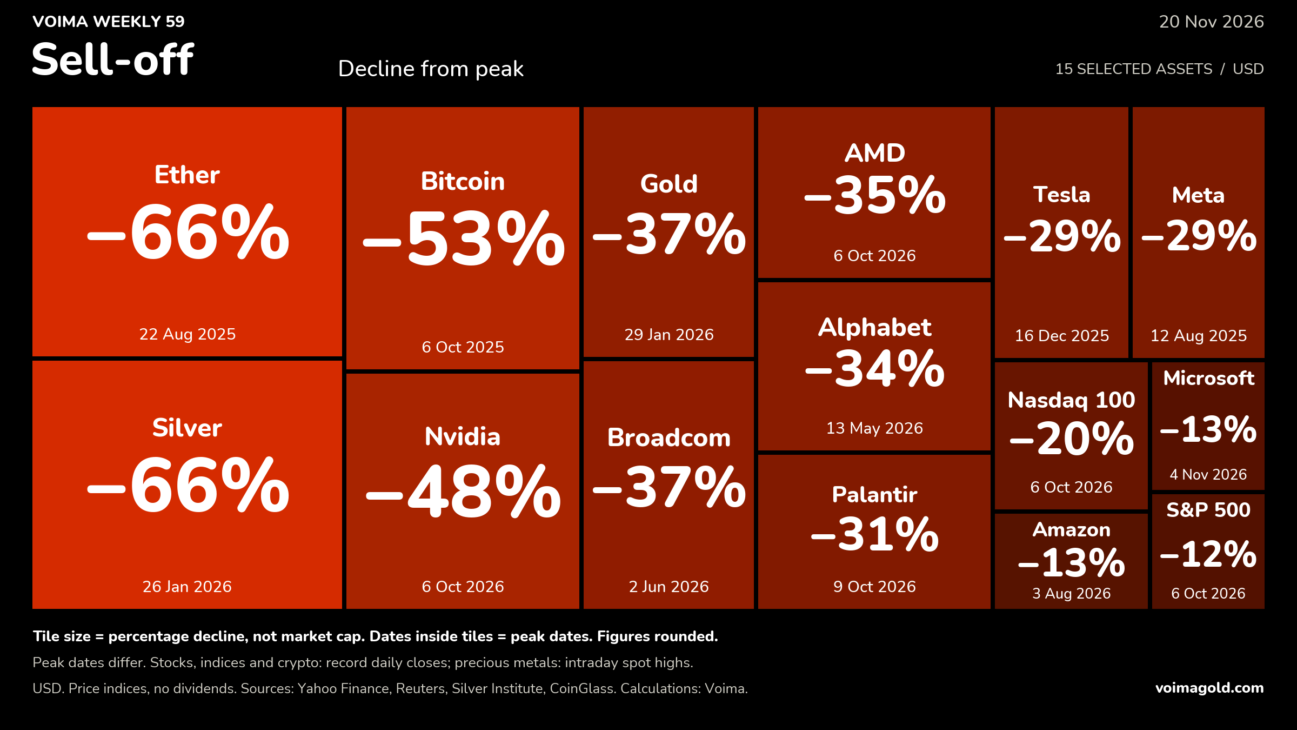
Decline from each market's peak, 15 selected assets, USD. Sources: Yahoo Finance, Reuters, Silver Institute, CoinGlass. Calculations: Voima.
Gold, silver, equities and bitcoin have fallen sharply. At a time like this, it is worth asking about every holding: why am I investing in this, and have the reasons changed?
By Friday, 20 November, declines from each market's own peak were approximately as follows:
| Market (peak date) | Decline from peak |
|---|---|
| S&P 500 index (6 Oct 2026) | 12% |
| Gold (29 Jan 2026) | 37% |
| Silver (26 Jan 2026) | 66% |
| Nvidia (6 Oct 2026) | 48% |
| Bitcoin (6 Oct 2025) | 53% |
Figures are rounded and denominated in US dollars. Comparison periods vary according to the peak date. For equities and Bitcoin, the reference level is the record closing price; for precious metals, it is the intraday high.
Part of the explanation lies in the dollar and interest rates. Rising market rates and expectations of rate increases have supported the dollar and raised the opportunity cost of holding gold, which pays no interest. At the same time, falling equities and deleveraging increase the need for cash. Margin requirements and losses are also covered by selling gold, which can quickly be converted into cash.1
Yet the traditional relationships between gold, the dollar and interest rates have worked inconsistently in recent years. Gold has also risen alongside real interest rates. Moves in the dollar or interest rates alone therefore do not explain gold's performance.
Oil can put further pressure on this situation. More expensive energy increases importing countries' dollar bills and adds to inflationary pressures that can keep interest rates high. It is interesting to examine US policy towards Iran alongside the opening up of Venezuela's oil trade and America's own production. It is interesting to consider the real objectives of the war in Iran and how these moves are connected. For investors, the effects are transmitted through energy prices, inflation and interest rates. November's decline in oil prices has, in turn, eased price pressures.
A falling market can also develop while the money supply is growing. In the Voima Total Money Index's August calculation, global broad money was approximately $157.4 trillion. Annual growth, adjusted for exchange-rate effects, was 5.6 per cent. This describes the longer-term monetary environment, whereas an immediate need for cash can be decisive during a sell-off.
The current situation is not a copy of 2008. It is more useful to view it as a continuation of the developments that began then. Stimulus during and after the financial crisis and the pandemic, large-scale asset purchases, rising debt, a larger money supply and persistent government deficits have shaped today's environment.
In my view, however, the case for holding gold is at its strongest. My view rests on familiar factors: money supply growth, government deficits and exceptionally strong central bank demand. According to the World Gold Council's estimate, central banks bought a net 321 tonnes of gold in the third quarter. The five-year quarterly average was 227 tonnes.2
Gold is not a government or corporate debt obligation. Its existence does not depend on an issuer's solvency, nor can its quantity be increased by an interest-rate decision. These properties make it a valuable part of wealth even when its price falls.
I also find Friday's yield of around 4.9 per cent on the ten-year US Treasury very attractive. Alongside it, one must assess the purchasing power of the dollars received back and, for an investor thinking in euros, the exchange rate as well.3
An interest rate that attracts investors also increases the borrower's bill. US gross federal debt stood at around $40.7 trillion on 19 November, and the budget deficit for the fiscal year ending in September was around $2 trillion. Net interest on government debt amounted to about $1.14 trillion, just over a fifth of all annual federal revenues. With such a large debt stock, keeping interest rates high for a long time becomes expensive.4
For silver, I look above all at current supply and demand. According to the Silver Institute's November estimate, industrial use this year is around 22 per cent above its 2019 level, although it is declining by around three per cent from last year. The overall market is forecast to record its sixth consecutive year of deficit, with a shortfall of around 35 million ounces.5
Much of silver mine output is a by-product of mining other metals, so supply does not depend on the silver price alone. A deficit can still be covered from existing inventories. The imbalance between supply and demand can therefore persist even as prices fall. This is the context in which I assess a price of around $41 an ounce.6
The same return to fundamentals applies to AI stocks. AI has become an inseparable part of work. Yet company valuations must still be assessed against earnings, free cash flow, growth expectations and the returns customers receive on their investments.
FactSet's report published on 20 November sheds light on broader equity market valuations. The S&P 500's forward 12-month P/E ratio was 17.1, compared with a ten-year average of 19.1. Valuations have moderated, but the resilience of earnings forecasts must also be assessed. A decline from the peak alone does not determine an investment's attractiveness.7
In the news flow, everything is fast, dramatic and final. Everything is collapsing, everything is changing, nothing will ever be the same again. A single down day can dominate the discussion even when the same investment is still up over three months.
This calls for patience from investors. Not everything has to deliver a return every day, and building for the long term does not follow the news cycle's timetable.
The same large companies sit at the heart of many indices and portfolios. Nvidia, like other megacap stocks, is followed around the world, information travels fast, and considerable leverage can be built around the same expectations. When expectations change and leverage is unwound simultaneously, market moves can intensify.
In Weekly #44,8 I wrote about the difference between volatility and a permanent loss of purchasing power. A long time horizon, avoiding leverage and a durable reason for holding an investment help us make use of price fluctuations. Sufficient liquidity, in turn, reduces the risk of being forced to sell at the wrong time.
Oil, the dollar and monetary policy were also central to markets in the 1970s. By 1976, gold had almost halved from its 1974 peak. Over the next three and a half years or so, the dollar's value measured in gold fell by nearly 88 per cent. The same dollar could buy only around one-eighth of the previous amount of gold.9
The world did not come to an end in 1980. Gold had risen in value to a new level in dollar terms amid inflation, oil crises and distrust in money. Tighter monetary policy later restored confidence in the dollar and also changed the direction of gold prices.10
The example shows how a sharp decline can occur within a long bull market. In the midst of it, the holder must make decisions without knowing what lies ahead.
That is precisely why I return to the positioning discussed in Weekly #56.11 What am I aiming for? Which risks have I positioned myself against? Has the environment changed in a way that undermines the original rationale?
The same questions apply to one's entire wealth. Equities can be held for corporate earnings and growth, fixed income for cash flow, and gold for diversification and preserving purchasing power. Different holdings can serve different purposes within the whole. More moderate equity valuations, government bond yields and lower commodity prices make this, in my view, an interesting market for building a diversified portfolio. At the same time, I consider it likely that the money supply and debt will continue to grow. Today's opportunities should therefore also be assessed in terms of wealth's long-term purchasing power.
Paradoxically, the same assessment applies to cash. Its purpose may be to finance a future investment. When the price of the planned purchase falls, cash's purchasing power relative to that purchase rises. Cash and short-term, high-quality fixed-income investments can therefore be a well-founded, and in this market even comfortable, position for someone waiting to invest.
In managing wealth, the essential task is to align holdings with one's own goals and retain the ability to act even on difficult days. When assessing a buying opportunity, I therefore look at the price, the reasons for holding the investment and how long the capital can be committed.
I now see an attractive buying opportunity in gold and silver. In my view, the investment case is strong, and the sell-off offers an opportunity to strengthen positions at a lower price than before. Perhaps it is worth focusing on what we want to hold even after this sell-off.
–Marko Viinikka
Founder, CEO
Voima Gold Oy
Disclaimer: Voima Weeklies are the personal writings of the undersigned. They do not necessarily represent the official view of Voima Gold Oy or any other company, nor do they constitute investment advice or a recommendation to purchase securities.
-
Kitco, 20 Nov 2026; Fed rate decision, 28 Oct 2026 ↩
-
World Gold Council: Gold Demand Trends Q3 2026, Central Banks, 3 Nov 2026 ↩
-
U.S. Treasury: Daily Treasury Par Yield Curve Rates, 20 Nov 2026 ↩
-
U.S. Treasury: Debt to the Penny; CBO: fiscal year 2026 budget review, Tables 1 and 3 ↩
-
Silver Institute / Metals Focus: 2026 supply and demand estimates, 12 Nov 2026 ↩
-
Kitco: silver prices, 20 Nov 2026; Silver Institute: supply and demand ↩
-
FactSet Earnings Insight, 20 Nov 2026, pp. 1 and 12 ↩
-
Voima Weekly #44 – Is Gold in a Perpetual Bull Market? ↩
-
Daily gold prices 1974; daily gold prices 1976; London PM price history ↩
-
Federal Reserve History: The Great Inflation; gold price history ↩
-
Voima Weekly #56 – Positioning Begins with a Clear Picture of the Situation ↩
You may like these
Below you will find related Voima Weekly publications where we explore economic developments, purchasing power, and the role of gold from different perspectives.2026-11-16
Voima Weekly #58 – The Price of Stimulation
A Roman cattle prod, energy drinks and central bank stimulus share one temptation: temporary relief without fixing the root cause. Stimulus works, until it becomes the system.
2026-11-09
Voima Weekly #57 – Looking Beneath the Price
A kilogram of gold costs 850,000 yuan, €120,000 or 20 million yen, yet it is the same kilogram. The price says more about the money than about gold.
2026-11-02
Voima Weekly #56 – Positioning Begins with a Clear Picture of Where We Stand
Positioning begins with an honest picture of where we stand. Gold's October 30 drop and the long-term money backdrop are two different time horizons.
