Voima Weekly #55 – To the Moon
Marko Viinikka
Toimitusjohtaja
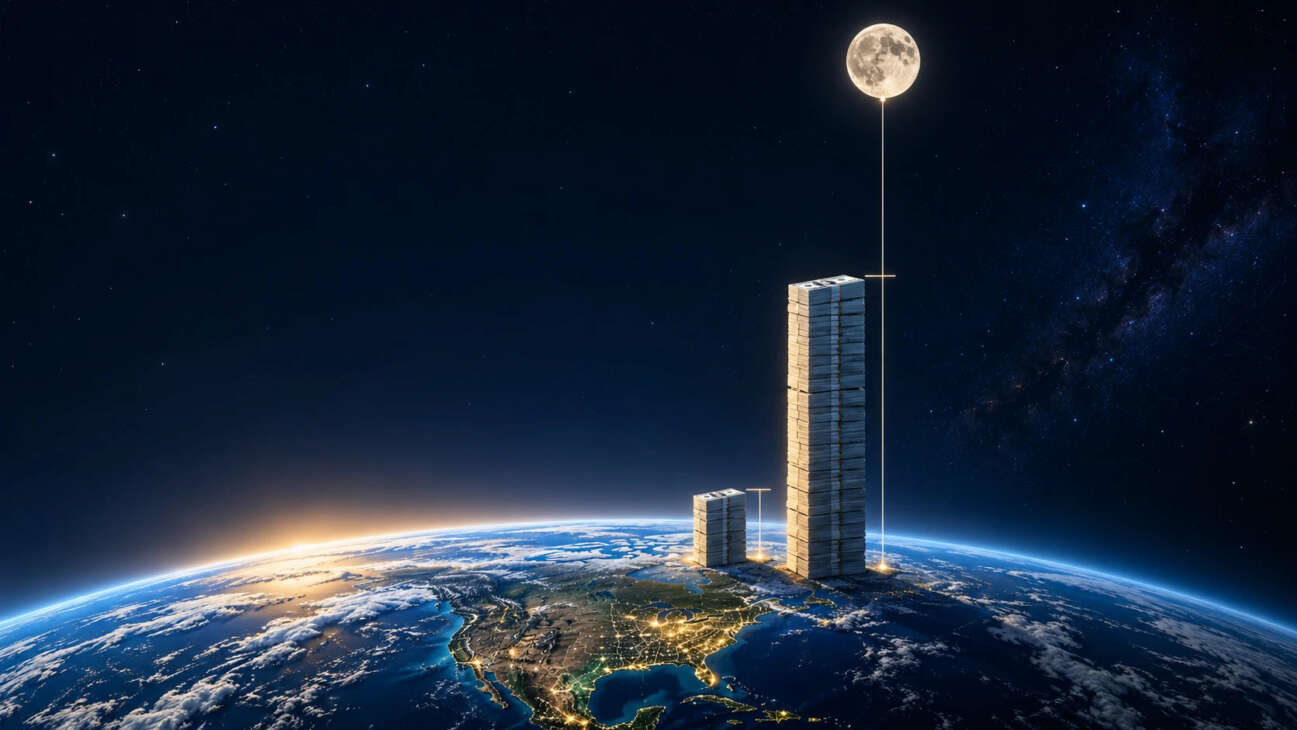
The world’s broad money supply stacked in $100 bills: the April 2003 stack would reach geostationary orbit, while the August 2026 stack would extend almost halfway to the Moon.
One of the fundamental questions in economics is simple: how much money is there in the world, and where is it’s quantity growing? The answer matters not only to investors, but also to companies, households and ultimately entire economies. We all make decisions in an economy where the quantity of money, its purchasing power and the prices of assets change.
When the stock of money and credit grows, the increase does not reach every part of the economy at the same time or in the same proportion. Investors try to assess where the new money will flow first. It may increase demand for an asset; such as a commodity or a share, and push up its price. Over the long term, research has often found money growth and rising price levels to move together. The strength of this relationship varies, however, and over shorter periods it is neither constant nor one- to-one. It is also influenced by production growth, the velocity of money, demand for credit and the monetary policy environment.1
Tracking the quantity of money helps us understand this environment. It does not tell us where new money will flow next, but it provides a starting point for assessing which assets may benefit from the growth of money and credit, and which may receive less of it.
We have built the Voima Total Money Index, or VTMI, to help answer this question. It brings together measures of broad money from different economies, including cash, deposits and other close substitutes for money. The index covers 15 major economies and around 120 others. The current time series runs from April 2003 to August 2026. Since national definitions differ, the index provides an indicative measure of how broad money is evolving.2
According to the VTMI, the world’s broad money stock stood at approximately $157.4 trillion in August 2026. At constant exchange rates, it increased by $8.3 trillion, or 5.6%, over the previous 12 months. From approximately $33 trillion in 2003, the total has grown almost fivefold in current US dollar terms.
The scale can be illustrated with $100 bills. If the world’s broad money stock were converted into $100 bills and stacked, the April 2003 stack would reach about 36,000 kilometres high. By August 2026, it would reach about 173,000 kilometres, almost halfway to the Moon. This is an illustration of scale: broad money consists mainly of deposits and other monetary assets, not physical banknotes, of course.3
The Voima Total Money Index has not yet been officially launched as a finished tool. We are making the current version of the table available to readers at the end of this Weekly while continuing to develop the index and compare its figures with other data sources.
The VTMI is part of a broader effort to build Voima’s macroeconomic research capabilities. We want to develop tools that help us follow the direction of the economy, test assumptions and assess the factors affecting different markets.
The money supply is heading for the Moon. We want to understand what is driving that growth and how it affects the real world. We aim to put that understanding to work for our clients. Our Weekly articles and accessible Voima Account are part of the same idea: helping people make better decisions and serving them through different economic conditions. We will continue developing this work.
At the end of this Weekly, you will find the currency tables and, now, the Voima Total Money Index. Your email app may truncate the message preview. If needed, click “View entire message” to read the full Weekly and see the tables.
I welcome your feedback on the Weeklys, as well as questions you would like us to address in future editions.
–Marko Viinikka
Founder, CEO
Voima Gold Oy
Disclaimer: Voima Weeklies are the personal writings of the undersigned. They do not necessarily represent the official view of Voima Gold Oy or any other company, nor do they constitute investment advice or a recommendation to purchase securities.
-
The relationship between money growth and inflation has been discussed by, among others, Isabel Schnabel of the ECB in “Money and inflation” (2023); Claudio Borio, Boris Hofmann and Egon Zakrajšek in BIS Bulletin No. 67, “Does money growth help explain the recent inflation surge?” (2023); and Helge Berger, Sune Karlsson and Pär Österholm in IMF Working Paper No. 23/137, “A Note of Caution on the Relation Between Money Growth and Inflation” (2023). Their work finds that the strength of this relationship varies over time and across economic environments. ↩
-
The notes accompanying the table describe the index definitions, data coverage and treatment of exchange rates. A more detailed methodology is available upon request. ↩
-
The banknote-stack calculations assume that a $100 bill is approximately 0.11 millimetres thick. The comparison between the 2003 and 2026 dollar totals is also affected by exchange-rate movements and changes in data coverage. The $8.3 trillion increase over the previous 12 months is calculated at constant exchange rates. ↩
You may like these
Below you will find related Voima Weekly publications where we explore economic developments, purchasing power, and the role of gold from different perspectives.2026-10-05
Voima Weekly #52 – Gold as Collateral for Government Debt?
The U.S. national debt has passed $40 trillion, and gold has entered the conversation. Could gold become collateral for a new kind of government bond?
2026-09-28
Voima Weekly #51 – Money and the Right to Step Outside the Digital Chain
Cash, Bitcoin and gold leave different traces. Gold can leave the digital chain, and return to it, without carrying every past transfer with it.
2026-09-21
Voima Weekly #50 – Winter Is Not a Matter of Opinion – Why Do I Write the Weekly?
The Weekly’s readership has grown to more than 4,000 subscribers. Marko Viinikka returns to the beginning: why the Weekly exists, how the economic weather is changing, and why Voima was built.
